Almost as beloved as the works of Shakespeare is the pastime of speculating about Shakespeare. With the possible exception of Jesus, one is hard-pressed to think of another figure in Western history about whom so little is known and yet so much is written. Even as the undisputed facts of the Bard’s life, though they are certainly more numerous than could be expected for a playwright living in the 16th century, remain maddeningly few (and maddeningly quotidian) works purporting to unravel the mysteries of Shakespeare the man – his personal beliefs, familial relationships, even his sexual inclinations – multiply unabated.
Ironically, the very meagerness of the historical record has been something of a boon to this Shakespeare industry, lending credence to an entire subgenre of sometimes wildly speculative notions from authors perhaps overeager to find some new revelatory scrap in the thoroughly picked-over carcass of Shakespearean scholarship. One need only glance at the veritable library of books devoted to this pursuit to uncover head-spinning pronouncements insisting that Shakespeare was a secret homosexual, a Catholic spy, or the author of the King James Bible — to name just three theories that have been seriously floated in recent years. Besides their implausibility, all share a common theme: Shakespeare was an extraordinary writer, and so it stands to reason that he must have led an extraordinary life.
This desire to aggrandize the life of Shakespeare has found its perhaps inevitable conclusion among those who choose to dispense with that life altogether. These “anti-Stratfordians” — a motley and growing assortment of intellectuals, fringe academics, and devoted dilettantes — contend that the paltry list of humdrum facts surrounding the life of the man from Stratford-upon-Avon could not possibly describe the same genius who produced such monuments of English literature as Hamlet and King Lear. In the poor player’s stead, the anti-Stratfordians have argued for a host of late 16th century luminaries who were supposedly better equipped to be Shakespeare than Shakespeare, a list that’s included everyone from Christopher Marlowe to Francis Bacon.
This “authorship question” has been making the rounds for over two hundred years, but the 20th century saw the debate pick up steam, and not just among well-read cranks – along the way the anti-Stratford movement acquired such famous adherents as Sigmund Freud, Mark Twain, and Malcolm X. What led these men, along with so many others, to adopt a theory that mainstream scholarship had so completely and convincingly dismissed? And why, in the light of overwhelming evidence for Shakespeare as the true author of the works bearing his name, does the debate continue to flourish?
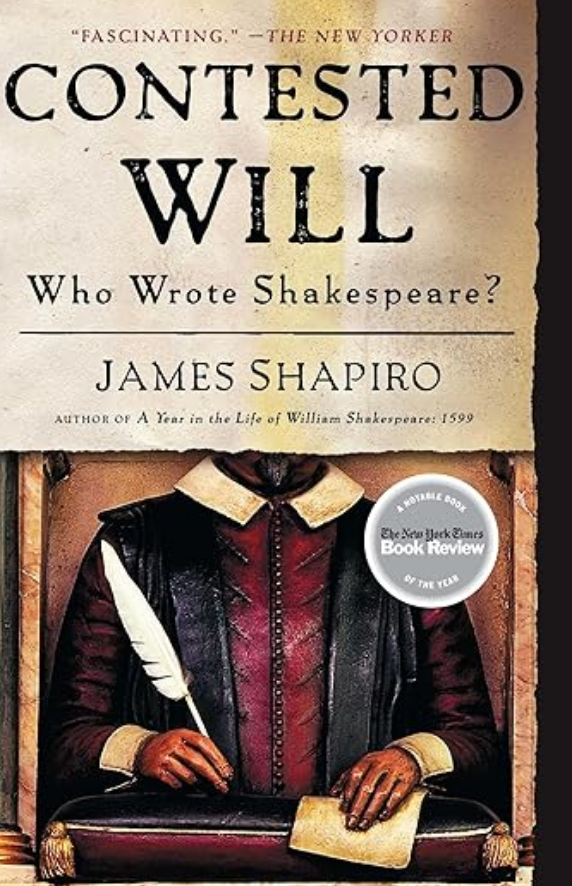
Those are the questions James Shapiro’s Contested Will: Who Wrote Shakespeare attempts to answer. Shapiro isn’t so much concerned with making the case for Shakespeare’s authorship (though he does dutifully trot out the evidence in the book’s final chapter) as he is in profiling some of history’s more well-known Shakespeare deniers in an attempt to make sense of the underlying question in this strange debate: Why, to put the matter simply, isn’t Shakespeare good enough?
The reasons range from simple classist snobbery to a need among some to either exalt Shakespeare on the one hand or dethrone him as a bolt-from-the-blue literary god on the other. But for Shapiro, the fundamental disagreement between Shakespeare boosters and those who argue for someone else as the author is essentially a philosophical one. On one side are the anti-Stratfordians, many (but not all) of whom methodically disassemble the plays and poems for insight into what “Shakespeare” thought, felt and directly experienced, reasoning that he couldn’t have possibly composed his works without leaving some trace of himself — intentional or not — behind.
On the other are Stratford supporters like Shapiro, who take an agnostic view regarding just how much of his life Shakespeare transmuted into art and argue that it doesn’t much matter anyway — Shakespeare surely borrowed from books, recycled overheard stories, and invented from whole cloth as much as he drew from the details of his own life when writing – everything is impossibly tangled together. These different approaches to reading Shakespeare, Shapiro argues, collapse into one simple question: can fictive literary works exist as independent creations wholly removed from their authors’ experiences and feelings? In other words, does the author of a written work of fiction necessarily stamp her head and heart onto every page of her creation, leaving her true self buried somewhere in her art, where it patiently waits to be teased out by those perceptive enough to uncover it?
For most anti-Stratfordians, and indeed for many modern observers who accept the view that Shakespeare from Stratford was the author of the works, the answer to the last question is a resounding “yes.” One need only survey the most recent Shakespeare pseudo-biographies to find critics citing passages in the plays as evidence of everything from Shakespeare’s true religious affiliation to his feelings about the death of his son. But the anti-Stratfordians, not content to simply psychoanalyze Shakespeare through his writing, build on this assumption by arguing that the humble glover’s son couldn’t possibly have written the plays and poetry attributed to him, because he couldn’t possibly have known about or experienced most of what he wrote. They point to the Stratford Shakespeare’s lack of formal education, his provincial status, and his largely cloistered existence as evidence that he would have been incapable of producing the works attached to his name, with their erudition, worldliness, and intimate knowledge of royal courts.
As Shapiro makes clear, such readings of Shakespeare are all based on a singularly modern (and mistaken) way of interpreting the works, one which assumes that all writing is, on some level, autobiographical. We want to find Shakespeare somewhere, and given the dearth of other information about him, what he wrote down is the best and only country we have to explore. But as Contested Will affirms, the profound humanity of the works can sometimes lead us astray, and when we gaze too long into the seductive mirror of Shakespeare’s worlds, we may sometimes forget that it is our own reflection staring back at us.