Sadako Sasaki was born in Hiroshima, Japan on January 7th, 1943. She was just two years old on the morning of August 6th, 1945, when the US bomber Enola Gay, situated some thirty-one thousand feet above, released upon the unsuspecting population of her city a weapon more deadly than any yet conceived by humankind — the atom bomb.
Exploding 1,900 feet overhead and roughly a mile away, the bomb blew the young Sadako from her home, yet – amazingly – left her relatively unscathed. Her mother, who managed a barbershop in Hiroshima (her father had been drafted into the Japanese army) scooped her only daughter up in her arms and fled in fear, as fire began to consume everything in sight. Carrying the child through a black rain of radioactive soot and debris, she was able to make her way to safety. Both mother and child had survived the initial blast. They were lucky – at least 70,000 people were already dead.
Three days later, another bomb fell on Nagasaki. Six days after that, the war was over.
The Sasaki family, like so many families in the post-war world, worked hard to rebuild their lives amid the devastation. Ten years after the bombing, the family opened a new barbershop to replace the one destroyed in the blast. Sadako had gone off to school, where she was an excellent student and a champion runner for the track team. The normal rhythms of life, slowly, were beginning to return.
But something was terribly wrong. One day, Sadako collapsed during a race. Lumps began to appear on her neck and behind her ears. She was taken to the hospital, where she was initially diagnosed as having the mumps. Later, however, it was realized that Sadako was suffering from something much more serious: leukemia — brought on as a result of radiation exposure in the Hiroshima blast.
From there the disease took its inexorable course. Sadako lingered in the hospital for a short time. In October of 1955, having by then lost the ability to walk due to her swollen legs, she died at only twelve years old. A delayed victim of atomic warfare, which by the time of Sadako’s death had already claimed some 220,000 lives.
***
Only four years before Sadako Sasaki drew her first breath in the world, her fate had been sealed. The death knell was seemingly the most innocuous of occurrences: the publication of a physics paper in Die Naturwissenschaften, a German scientific journal. The year before, on the 17th of December, 1938, the Germans Otto Hahn, Fritz Strassmann, and Lise Meitner, building on the work of Enrico Fermi, had successfully split the nucleus of a uranium atom into the lighter element barium by bombarding it with neutrons, releasing a burst of energy. The trio, as they correctly induced at the time, had discovered nuclear fission. The publication of their findings in Die Naturwissenschaften on January 6th, 1939 brought their revolutionary discovery to a world teetering on the brink of war.
Things moved rapidly following announcement of the findings, as the work spread to the physics community at large. In New York, physicists Leó Szilárd and Enrico Fermi confirmed that the fission process released excess neutrons, making a self-sustaining chain reaction, in which the extra neutrons repeat the process of fission again and again, possible. From there, it was easy to see that an uncontrolled reaction might result in the release of a tremendous amount of destructive energy.
The implications of this were immediate and frightful, not least of which to Szilárd, who rushed an admonitory letter to Franklin D. Roosevelt (after convincing his old friend Albert Einstein to sign) informing him of the potential destructiveness of a weapon built upon this newly discovered process — and the consequences if such a weapon were to be used by the Nazis, who a month earlier had sparked World War 2 with the invasion of Poland, first. FDR, understandably alarmed, ordered the creation of a “uranium committee” to explore the feasibility of constructing an atomic weapon. The committee marked the beginning of the American bomb program.
A few months earlier, leading American physicist J. Robert Oppenheimer, then a professor at Caltech, found the very idea of fission hard to swallow. “That’s impossible,” he told colleague Luis Alvarez upon being informed of the Die Naturwissenschaften article. But the next day, Alvarez successfully replicated the German experiment with Oppenheimer looking on. Now convinced, he, like Szilárd, almost immediately envisioned one application of the new discovery, remarking that “…a ten cm cube of uranium deuteride […] might very well blow itself to hell.”
***
Oppenheimer’s realization came with a rapidity that was characteristic of his enormous intellect. By the time he was nine, he spoke both Latin and Greek; in the fifth grade, he was already studying physics and chemistry. By any accounting he was a genius, and one who was to fully live up to his potential. Studying at Harvard, Cambridge, and the University of Göttingen, Oppenheimer did pioneering work in the then new field of quantum physics, eventually rising to star status as the de facto leader of the nascent school of American theoretical physics.
It was only natural then, that when the American race to build an atomic bomb switched into high gear — a British report suggesting that the Germans were well on their way to constructing their own bomb had increased the sense of urgency — the government would seek out Oppenheimer. Brought in on meetings of the uranium committee’s successor organization, the so-called “S-1 committee,” Oppenheimer so impressed committee chair James Conant that it was decided the young physicist should be the man to head the program to build an atomic bomb. After wrangling with the Army over Oppenheimer’s security clearance (this was necessary due to Oppenheimer’s earlier associations with “leftist” causes – associations that would prove damning after the war) Conant got his man, and the newly minted Manhattan Engineer District, AKA the Manhattan Project, got its director. Here then, came the moment that would forever define J. Robert Oppenheimer’s life and legacy.
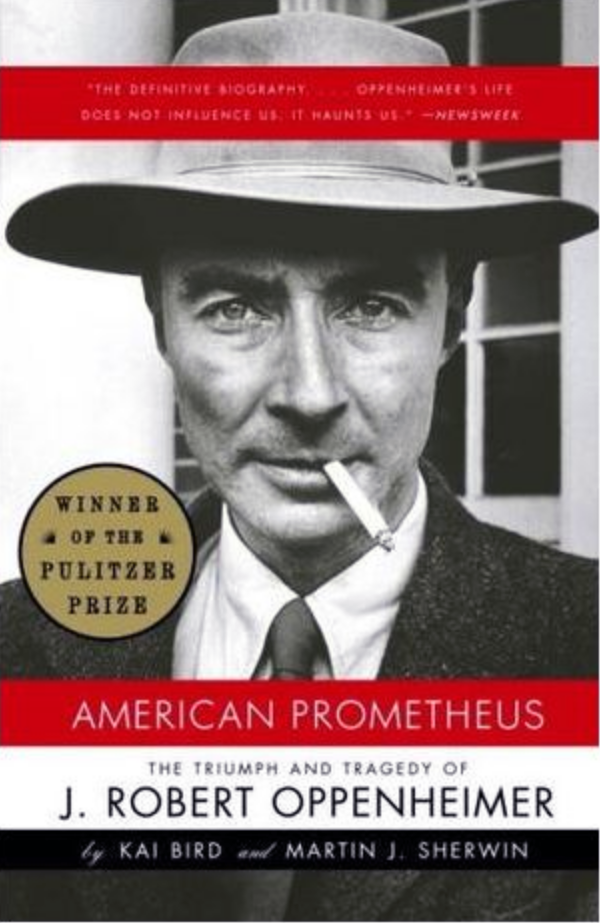
That life and legacy are explored in thorough detail by Kai Bird and Martin Sherwin in American Prometheus: The Triumph and Tragedy of J. Robert Oppenheimer. Their book is a biography so beautifully executed and well-researched that it’s impossible to imagine a more definitive version ever appearing.
That said, pinning down the definitive J. Robert Oppenheimer might be beyond the scope of any book. Certainly, the man that emerges from the pages of American Prometheus appears, at first glance, to be a walking contradiction. Attending New York’s Ethical Culture Society School as a child, Oppenheimer was educated in a liberal tradition built upon a stringent ethical framework, and was by all accounts a man keenly aware of the sufferings of others, so much so that he was often proactive in attempting to allay those sufferings where he could, which led him to fleeting associations with Communist groups in early adulthood (Oppenheimer himself was never a party member).
Though neither an idealist nor a pacifist, Oppenheimer was clearly possessed throughout his life of a deep-seated empathy for his fellows. How then, could this be the same man who, in the days leading up to the bombing of Hiroshima, carefully instructed American bombardiers on when and under what conditions to drop the bomb, so as to cause the maximum death toll? How could this be the same man, who, when James Conant circumspectly suggested the targeting of civilians for the initial bombardment, voiced no objections?
If this was the central paradox of Oppenheimer during the years in which he coordinated the building of the atomic bomb — of a thoughtful and intelligent man driven to aid in the annihilation of hundreds of thousands of civilians — it should be noted that it was a paradox internalized by many during a time in which the very destruction of the American state seemed a daily, and quite tangible, possibility. Oppenheimer believed, as did most of the scientists building the bomb, that the work in which they were involved was absolutely vital to stopping Hitler and ending the war. And perhaps, as Oppenheimer mused, ending all wars, through the unhappy doctrine of mutually assured destruction. If some physicists, such as I. I. Rabi, refused to take a direct part (Rabi told Oppenheimer that he didn’t wish to see such a weapon become “the culmination of three centuries of physics”) so be it, but for good or ill, the genie was out of the bottle — and better that Americans controlled it than Nazis.
But the notion of the atom bomb as peacemaker soon grew more difficult to justify. On May 7th, 1945, Germany surrendered, ending the war in Europe. Japan by that time was effectively defeated and, as the Allies knew thanks to information contained in intercepted communications, was seeking terms of surrender.
But there would be no stopping the bomb. On July 16th, 1945, the Manhattan Project culminated with the successful detonation of the world’s first nuclear weapon, in a test Oppenheimer dubbed “Trinity” (in a choice that would seem to reveal much about his own philosophical trepidation, Oppenheimer took the code name from a line by poet John Donne: “Batter my heart, three-person’d God”).
Given the state of the war, the only question remaining was whether it made sense to use the bomb against the Japanese. For President Harry Truman – not exactly a man to wrestle with his conscience – this was a foregone conclusion. Though his motivations are still debated, one thing was certain: if dropping the bomb could no longer be justified as the death-stroke with which to end World War 2, it would indeed make a devastating opening salvo at the dawn of the Cold War. And so it did. With the USSR’s detonation of its own atomic bomb in 1949, the course of history for the next forty years – which saw civilization hovering on the brink of nuclear annihilation – was cemented.
But at the time, Oppenheimer attempted to use his new found celebrity and Washington connections to avoid the massive arms race that he was prescient enough to see coming. He was a staunch proponent of what he referred to as “candor” — sharing atomic information with the Russians openly in an effort to avoid secrecy and build trust, and he vehemently opposed both the development of the Hydrogen bomb and the creation and stockpiling of more nuclear weapons, rightly regarding both as militarily useless.
Unfortunately for Oppenheimer, such common sense views were anathema to a now deeply entrenched Washington establishment that married both an acute misunderstanding of science with a fatalistic foreign policy that bordered on collective paranoia. President Truman, for one, didn’t believe the Soviets could build an atomic weapon. Oppenheimer, for his part, knew that fundamental truths of nature could not be locked behind national borders.
In the poisonous atmosphere of the McCarthy era, it seemed inevitable that that same Washington establishment, who opposed Oppenheimer’s recommendations and feared his influence, would seize upon his past associations with Communists as a means of removing him from the policy debate altogether. Just this happened when, from April 12th – May 6th, 1954, Oppenheimer was subjected to a hearing in which the decision on whether or not to rescind his top-level security clearance would be decided. Largely the work of Atomic Energy Commission chair Lewis Strauss, the hearing soon devolved into a show trial with one ostensible, and patently absurd, purpose: to paint the father of the atomic bomb as a risk to the security of the nation. In this, it was only partially successful. In its actual purpose, however — to permanently excise Oppenheimer from Washington and silence his now unorthodox views, it succeeded all too well. Oppenheimer’s security clearance was revoked, and his influence was diminished until his early death from cancer at the age of sixty-three.
Despite American Prometheus’ exhaustive portrayal, Oppenheimer remains elusive. A man of supreme conscience and humanity, he is nevertheless intimately associated with inaugurating the era that may yet bring ruin to the world (somewhat unfairly of course — the bomb would no doubt have been built with or without Oppenheimer’s direction). A man of great integrity and patriotism, he was nevertheless driven by his loyalty to authority, and perhaps his intoxication with being an authority, to participate in an extralegal hearing whose only function was character assassination, thereby lending legitimacy to what amounted to nothing less than a politically motivated witch hunt.
***
In portraying a human being both timorous and vicious, detached and supremely engaged, American Prometheus does reveal one truth about Oppenheimer – maybe the truth – that here was a man as complex and contradictory as the country he loved, and the century he helped shape.