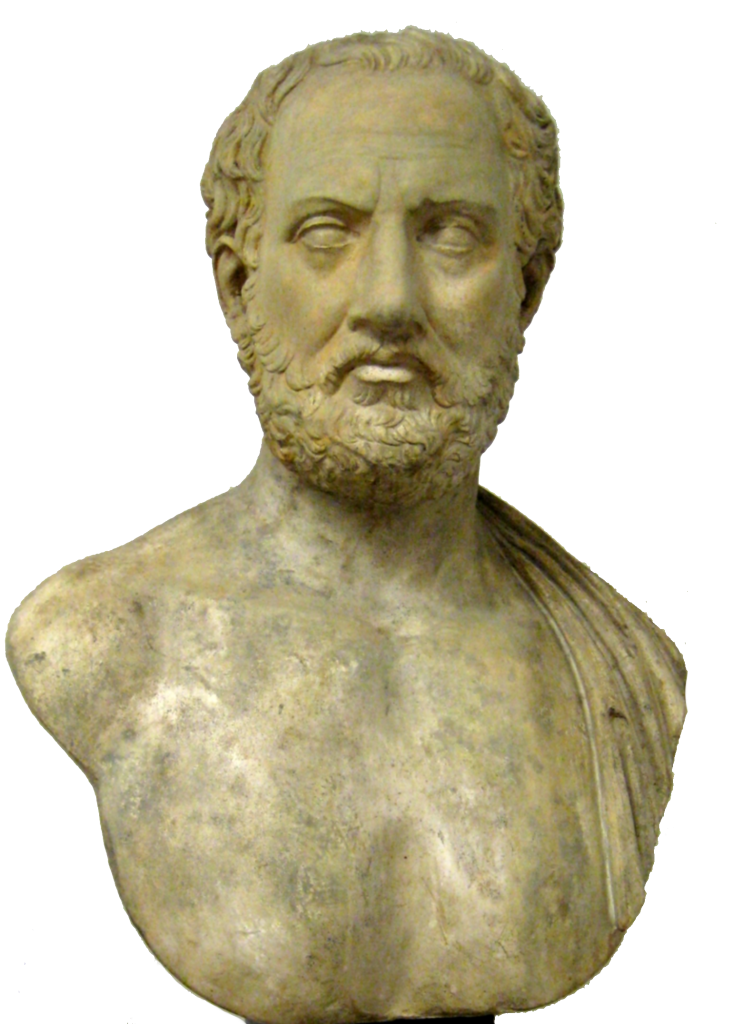
Forgive me for being presumptuous, but I think I can safely make the claim that Donald Trump has never read Thucydides. At this point it would be difficult to convince me that he has ever read a book.
Not being familiar with Thucydides isn’t a slam of course — I suspect the Donald would find himself in plentiful company on that point — but it is a shame. The fifth-century Athenian’s aeonian masterwork, The Peloponnesian War, a history of the twenty-seven year war between the ancient Greek city-states of Athens and Sparta, abounds with the sort of pragmatic wisdom that would seem to be especially relevant to those in power. These are folks, after all, who hold the reins of the dogs of war and, at least in the case of Trump, seem almost delighted at the prospect of simply tossing away the leash and collar.
Thucydides knew the price of war, of course. He saw fighting first hand as an Athenian general, and was later exiled from Athens for twenty years following his failure to save the allied city of Amphipolis from a force of invading Spartans (picture that — consequences!).
But the price of war is easily imagined by most anyone with an instinct for self-preservation; to truly understand why people have nevertheless been willing to pay it for almost all of our history requires some understanding of human nature, and Thucydides understood human nature about as well as anyone who ever wrote.
He knew the vagaries of fortune and the dangers of hubris. He proved an admirable skeptic when it came to matters of common knowledge (“So little pains do the vulgar take in the investigation of truth, accepting readily the first story that comes to hand.”) and he understood both the promise and danger of democracy.
Take this passage, in which Thucydides has Pericles, celebrated ruler of Athens during her golden age, take the Peloponnesians to task:
Slow in assembling, they devote a very small fraction of the time to the consideration of any matter of common concern, most of it to the prosecution of their own affairs. Meanwhile each fancies that no harm will come of his neglect, that it is the business of somebody else to look after this or that for him; and so, by the same notion being entertained by all separately, the common cause imperceptibly decays.
Sound familiar? Yes, I recognize the dangers of drawing identic parallels between our modern woes and those of the ancient world (if you ever hear anyone attempt to cast the USA as a direct descendant of the Roman Empire, run). But it would be a mistake to ignore completely the hard-won wisdom of Thucydides. (As he himself said, “there is no advantage to reflections on the past further than may be of service to the present.”) Though we may have nuclear subs in place of triremes, and assault rifles instead of spears, the men wielding those weapons are, though nominally separated by time and culture, essentially the same.
As a service to the reader, I’d like to provide a few more timely quotes, courtesy of Thucydides, that may prove enlightening (or possibly depressing).
Let’s begin then, with Thucydides’ take on the current American political climate. Err, I mean a bloody revolution in the Greek city-state of Corcyra:
Words had to change their ordinary meaning and to take that which was now given them. Reckless audacity came to be considered the courage of a loyal supporter; prudent hesitation, specious cowardice; moderation was held to be a cloak for unmanliness; ability to see all sides of a question incapacity to act on any. Frantic violence became the attribute of manliness; cautious plotting a justifiable means of self-defense. The advocate of extreme measures was always trustworthy; his opponent a man to be suspected.
And later:
The ancient simplicity into which honor so largely entered was laughed down and disappeared; and society became divided into camps in which no man trusted his fellow.
Still later:
In this contest the blunter wits were most successful. Apprehensive of their own deficiencies and of the cleverness of their antagonists, they feared to be worsted in debate and to be surprised by the combinations of their more versatile opponents, and so at once boldly had recourse to action: while their adversaries, arrogantly thinking that they should know in time, and that it was unnecessary to secure by action what policy could provide, often fell victims to their lack of precaution.
While it may prove expedient to believe that “the strong do what they will, while the weak suffer what they must” it is also wise to remember that strength and weakness are changeable conditions, hence a warning on ignoring the rule of law:
Indeed men too often take upon themselves in the prosecution of their revenge to set the example of doing away with those general laws to which all alike can look for salvation in adversity, instead of allowing them to subsist against the day of danger when their aid may be required.
And among those who find themselves weakest of all under Trump’s gangster state — our nation’s immigrants — a few wise words from the wisest of leaders, Pericles:
…We throw open our city to the world, and never by alien acts exclude foreigners from any opportunity of learning or observing, although the eyes of an enemy may occasionally profit by our liberality…
Turning to foreign adventures in arms, if recent history will not suffice, heed the following advice of the Athenian commander Nicias, who led an invading army of Athenians to overtake cities in Sicily:
We must not disguise from ourselves that we go to found a city among strangers and enemies, and that he who undertakes such an enterprise should be prepared to become master of the country the first day he lands, or failing in this to find everything hostile to him. Fearing this, and knowing that we shall have need of much good counsel and more good fortune — a hard matter for mortal men to aspire to — I wish as much as possible to make myself independent of fortune before sailing, and when I do sail, to be as safe as a strong force can make me.
The expedition was a spectacular failure, and Nicias was captured and executed.
Recall, then, that war is a messy affair:
…an Athenian ally, who some time after insultingly asked one of the prisoners from the island if those that had fallen were noble and good men, received for answer that the atraktos — that is, the arrow — would be worth a great deal if it could pick out noble and good men from the rest; an allusion to the fact that the killed were those whom the stones and arrows happened to hit.
Finally, a message to future leaders:
The virtue of men in office is briefly this, to do their country as much good as they can, or in any case no harm that they can avoid.
And:
A man may be personally ever so well off, and yet if his country be ruined he must be ruined with it.